
Dementia in Sport: A Time for Change
24th December 2020
Written by Olivia Fretwell.
There is an ever increasing body of research surrounding the link between playing contact sport and going on to develop Dementia and other neurodegenerative diseases later in life, especially in sports such as rugby, football and American football. After reading Steve Thompson’s moving interview in The Times, I wanted to find out more and see what current research was suggesting.
Part of England’s Rugby World cup winning side in 2003, Steve Thompson, aged 42, is one of a number of rugby players who are launching a legal claim against rugby’s governing bodies for alleged negligence and lack of proper protocols as regards high impact training regimes etc, leading to early onset dementia or chronic traumatic encephalopathy (CTE). CTE is a progressive degenerative disease of the brain, caused by repeat traumatic brain injuries (TBI) i.e. repeat concussion following repeated blows to the head or sudden/ severe forces causing movement of the brain within the skull. Symptoms typically involve short term memory problems, mood changes, increasing confusion and problems with decision making or thinking. Longer-term, symptoms may be for example slurred speech, serious memory impairment and other symptoms that are typically associated with Parkinson’s. Visit the NHS website here for more information (Source: NHS Website, 2020).
Even more recently, Adam Hughes, who is the youngest of the rugby players so far to publicise their issues, aged 30, has been told he is heading for the same diagnoses and associated issues as players like Steve Thompson. Doctors have advised him that TBI was caused by repeat concussions he sustained whilst playing 119 games before his retirement in 2018 (Aylwin, 2020).
The issue in rugby is not simply about the occasions when a player becomes obviously concussed during a game and gets taken off (or not in some cases), it is the continual sub-concussive hits, which occur below the concussive threshold, therefore many of the players/coaches will not notice; as Kearnan Myall describes it “every single tackle you make, every single ruck you hit, every single scrum you hit, every time you hit a bag in training” – this is the main issue that needs addressing (Kitson, 2020).
A very recent study by McNabb et al., (2020) found evidence for this; researchers found an increase in cSP (cortical silent period) after participants endured tackling exercises, compared to no cSP change in the control or ball carrier groups i.e. no tackling. This is significant as an increase in cSP is found in many neurological conditions for example atypical Parkinson’s and Huntington’s (Major, Rogers & Pearce, 2015). This study also found a measurable change in SICI (short interval intracortical inhibition) in the tackling and ball carrier groups which they have found is related to GABA activity and may suggest motor system abnormalities and memory impairment (Di Lazzaro et al., 2005).
Football is another sport that has come under scrutiny for lack of sufficient education of the longer term implications that heading the ball has on players’ longer term cognitive functioning. Alan Shearer released a BBC documentary back in 2017 showing the effects that heading the ball has on longer term brain functioning. Watch the full documentary on YouTube here.
Di Virgilio et al., (2016) investigated the direct immediate effect of heading the ball, and found measurable electrophysiological changes; increased intracortical inhibition among those players as they experienced repetitive sub-concussive impacts. Increased intracortical inhibition has been found to lead to cognitive impairments as well as being linked to Parkinson’s (Ridding et al., 1995a), dystonia (muscles contract uncontrollably) (Ridding et al., 1995b) and cortical myoclonus (muscle jerks) (Brown at al., 1996).
Another study released by the University of Glasgow in 2019 found that former professional footballers were approximately three and a half times more likely to die due to neurodegenerative diseases, alongside having a five times greater risk of Alzheimer’s, a four times greater risk of motor neurone disease and two times greater risk of Parkinson’s compared to population controls.
The facts are clear and highlight the link which needs addressing. The FA in February 2020 finally acknowledged the issue and put guidelines in place that forbid any children under the age of 12 from heading the ball whilst training. Some campaigners do not think this is sufficient to counteract the long term effects and want the ban to be up until the age of 18 (The Conversation, 2020). In reality however, children are still heading the ball incidentally in training and small games – this ban is not effective and more stringent guidelines need to be put in place. On the 23 December 2020, a letter was submitted to the culture secretary by politicians and former footballers, in the hope that more drastic change will materialise. This follows Nobby Stiles’ recent death linked to dementia. He was a 1966 England World cup winner, and sadly a further 5 members of this team have also been diagnosed with dementia (BBC, 2020); the desire and pressure for change is mounting.

(Photo by James Williamson – AMA/Getty Images)
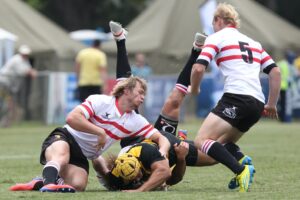
So, what can be done and what has been done? Within football, balls have been made lighter, however arguably this does not solve the issue as the balls are hit harder and hit the players head at an increased speed (BBC. Magowan, A., 2020). In rugby, it has been suggested there be a change in tackling technique; more skilled tackles may help to reduce the full impact, as well as a change to the ball carrier’s movement, to a more avoidant style of play (McNabb et al., 2020).
Besides changing how the sport is played, modernising the equipment used, there is an undeniable culture embedded within both these sports; players not wanting to leave the pitch despite medical advice, playing on even when they know they shouldn’t or in their concussed state not realising, not wanting to let the team down, not wanting to show any weakness. Ultimately playing sport at a professional level is a job, a select few are paid to be the best, they are expected to be “tough”, so why would they behave any differently? For some they are representing their country, millions watching them, relying on them, they cannot make a single mistake; the pressure on their shoulders is enormous. Arguably however they do it because they love the sport, but the shine is taken off the playing, when lives can be destroyed, and their long term health is at serious risk. Who should be held accountable then for the damage that is being done to the players’ brains? Governing bodies, coaching staff and doctors all have a duty to protect their players physical and mental health. Head coaches need to reduce the expectations, reduce the number of tackles/headers made in training, as well as removing the culture and pressure put on the players. They are so focused on the short-term immediate outcomes i.e. to win and be the best, they lack clarity and perspective of the long-term detrimental effects playing these sports is having. Steve Thompson is now riddled with guilt as his wife and four young children will have the burden of looking after him as the disease progresses.

(Photo by Andrew Tobin www.slikimages.com)
To conclude, the full impact and link between contact sports and dementia is still not fully understood and a lot more research and investment is required in order grasp the full extent and for proper change to be implemented from the top-down and bottom-up. There needs to be a proper evaluation of the balance between the players’ risk of concussion and the benefits of playing these contact sports. As Steve Thompson puts it in his interview with The Times “I don’t want to wreck rugby…I want to make it safer.”
We would love to hear what you think – share with us your thoughts and join in the conversation now on our social media! Linkedin Twitter Facebook #dementia #rugby #football #sportslaw #psychology