
Dementia – diagnosis, development and distress during Covid-19. Part 1.
28th April 2021
Introduction:
This piece has been formulated around three interviews which have taken place over the past few months. The interviews I have conducted include one with a clinical psychologist who specialises in dementia diagnoses, one with a care-home manager, and one with a family member of a care-home resident who is 5 years post-dementia diagnosis. Bringing these interviews together has allowed me to draw some key themes, as well as demonstrate with examples, the whole dementia ‘process’ – from a diagnosis, to reality, and longer term emotional implications of living with the disease. It is also a chance to highlight how physically and psychologically challenging this past year has been for many. Part 1 presents a broad introduction into dementia and the practicalities of a diagnosis.
Since the very beginning of the Covid-19 pandemic, many nursing/care-homes/residential settings have been devastated by the coronavirus, with thousands in the UK sadly losing their lives. Figures released by the Office for National Statistics show that between 28 December 2019 and 12 June 2020, 93,475 care home residents died from Covid-19 in England and Wales[1]. Because of the high death rate, strict visiting restrictions were put in place to try to stop the spread. As a result, many residents have been without direct face-to-face support from loved ones, resulting in a lack of social interaction and cognitive stimulation, both of which help to counteract the effects of dementia[2]. Dementia is the general term for “loss of memory, language, problem-solving and other thinking abilities that are severe enough to interfere with daily life”[3]. The most common cause is Alzheimer’s disease. 850,00 people in the UK are said to have dementia, with most of them being over the age of 65, and having other underlying heath conditions. This makes them extremely clinically vulnerable to Covid-19[4]. This pandemic will have undoubtedly left those in nursing homes feeling scared, abandoned, lonely and extremely isolated. On top of this, those with dementia will have found this last year extremely confusing and may not have understood what has been going on or why loved ones haven’t been able to visit.

Difficulties of the Diagnosis:
Diagnosing dementia, as described by the clinical psychologist, is a complex process and initially requires other conditions to be ruled out via physical examinations and screens. These are conducted to ensure nothing reversible is causing a patient’s dementia, for example an infection. A collateral and clinical history is then obtained – this enables the psychologist to distinguish any organic brain changes/problems or any functional (mental health) problems. This has to be done prior to cognitive testing, as if someone presents with, for example depression or anxiety, this must be treated first i.e. with therapy or medication. If these aren’t dealt with before, the cause of the identified impairments is then unknown. These may be differentiated for example by examining patients’ qualitative responses; someone with depression may say “I don’t know”, whereas someone with dementia may say “I’m sure that is correct”. You can also study patient’s behaviour i.e. a lack of motivation or effort may be seen in someone with depression.
In order to identify the exact dementia, brain scans may be used. For example, a CT brain scan might pick up hippocampal and medial temporal lobe abnormalities and suggest an Alzheimer’s diagnosis. However, sometimes CT brain scans don’t detect any brain changes or abnormalities, which may be the case if someone is younger or in the early stages. Here, only through neuropsychological testing or a further MRI scan (which can detect crucial differences that a CT scan cannot), can a dementia be identified.
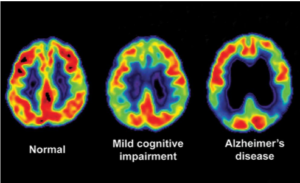
When psychologists assess someone for dementia, the approach to testing is hypothesis driven, with the same core battery of tests used the majority of the time. Cognitive tests may be added in/taken out depending on the patient’s presentation – a tailored approach. These tests will cover the core cognitive domains; visuo-spatial, executive, attention, memory and language.
Another crucial reason why the specific dementia must be identified is due to the fact that with some dementias, certain treatment i.e. medication in frontotemporal dementia, can make the dementia worse. A mixed diagnosis can also be identified, the most common being vascular dementia and Alzheimer’s. In this instance, different treatment is required to treat the different dementias. Alzheimer’s can be treated with medication, but to treat vascular dementia, it may require lifestyle changes. This is because vascular dementia can be linked to a lack of blood supply to the brain and be linked to a stroke or heart disease[6]. Getting the correct diagnosis therefore is vital.
As described by the psychologist, diagnosing someone with a dementia is a process of elimination and involves considering someone’s whole presentation as discussed above. Diagnostic difficulties were evident when I interviewed the family member as they had waited many months for a formal diagnosis because different medical professionals suspected different diagnoses – Alzheimer’s, vascular, Parkinsonian and mixed dementia. This was a desperate and frustrating situation as they felt powerless and feared the unknown.
After identifying and delivering the diagnosis, another difficulty is understanding and processing it. What does the diagnosis mean in reality? For some, a dementia diagnosis is a complete shock and entirely devastating. This is especially so for those who are diagnosed with early onset dementia at a younger age. It is crucial in this instance to ensure the right support is in place early on, as they may still be caring for a young family for example. For others however, a diagnosis might be a relief because it acts as an answer and explanation for the problems they were experiencing. For the family member I interviewed, they witnessed their loved-one gradually deteriorate in function, as he struggled to care for himself and process simple instructions. This was described as a real “penny-drop moment” for the family, however they saw the diagnosis as a relief, and a new beginning to ensure that proper support and care could be put in place. In this instance and for many others, this came in the form of moving into a care home.
We hope the first half of this piece on dementia during Covid-19 has provided some background and insight into the process of diagnosing someone with dementia and the impact this can have. Please look out for the second half of our dementia piece, coming soon.
[1]https://www.ons.gov.uk/peoplepopulationandcommunity/birthsdeathsandmarriages/deaths/articles/deathsinvolvingcovid19inthecaresectorenglandandwales/deathsoccurringupto12june2020andregisteredupto20june2020provisional
[2] https://www.ageuk.org.uk/globalassets/age-uk/documents/reports-and-publications/reports-and-briefings/health–wellbeing/rb_oct14_cognitive_decline_and_dementia_evidence_review_age_uk.pdf
[3] https://www.alz.org/alzheimers-dementia/what-is-dementia
[4] https://www.alzheimers.org.uk/about-us/news-and-media/facts-media
[5] https://www.nursingtimes.net/news/research-and-innovation/disappointment-as-promising-drug-fails-to-slow-dementia-23-11-2016/