
E-scooters – E for effective or excruciating?
7th August 2020
Written By Olivia Fretwell.
E-scooters – E for effective or excruciating?
Overnight, electric scooters appeared everywhere and anywhere we looked; dividing public opinion in the process. Some saw them as a danger to pedestrians and other road users, particularly as some users were without a license and lacked sufficient road knowledge. The scooters’ silent nature means problems for blind and vulnerable individuals with other disabilities. For a period of time proper rules and regulations were not in place and they ran havoc in many European countries and across the world. Others however saw their benefit. For example, they have been trialled as part of the Government’s £2 billion package, as part of the attempt to help reduce and slow Covid. They are argued to relieve the numbers on public transport and reduce car emissions, creating a “greener alternative” and allowing for social distancing.
Whilst their benefits are favourable and understandable from the perspective of the current global pandemic, what about their impact on the rider’s safety and road traffic accidents? A terribly sad example in the UK is of YouTuber Emily Hartridge who died in 2019, after a collision with a lorry in London whilst riding an e-scooter. Additional figures speak for themselves: within a period of four years, 40,000 people have required a hospital admission and A&E treatment, with almost a third of people suffering head trauma as a direct result.
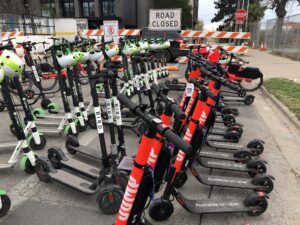
People have greatly underestimated their danger and measures must be taken seriously and properly enforced to ensure public safety for all involved. For example, wearing helmets should be deemed as essential, strongly encouraged and actually enforced by the Government and police, an argument put forward by Peter McCabe (chief of Headway). There is clear evidence that wearing a helmet saves lives and stops long-term disability, as it reduces the risk of serious head injury by 70% and fatal head injury by 65%. A recent study conducted in the US found the risk of head-injury being twice as likely when on a e-scooter than a bike. Furthermore, a study in Stockholm showed the injury rate to be eight times higher on an e-scooter compared to a bike. This highlights how serious choosing to take this mode of transport is, and the life-changing consequences it may have for the rider. Riders must understand the relevant rules and that the measures put in place are for their safety.
Steps have been taken by the UK Government, as they have produced and set out guidelines and specific rules that must be met and adhered too by all involved, including the companies that produce the products. For example, the single person riding an e-scooter must have a valid driving license and motor vehicle insurance; local authorities must adapt their cycle lanes to adhere safely and effectively to the rules; the actual vehicles being speed limited to 15.5mph and tampering with this being a criminal offence. A further hopeful benefit, which has been highlighted by the charity RoadPeace, is that they provide an alternative mode of transport to cars or motorbikes, which may in turn reduce the number of high-speed road collisions and a reduction in casualties if enough people use e-scooters safely and with proper protection.
What do you think? Do the costs of the risk to public safety and rider safety outweigh the benefits of a green replacement to public transport and help to adhere to social distancing? Or do the benefits outweigh the costs? Join in the debate and let us know your thoughts.
References:
- £2 billion package to create new era for cycling and walking. (2020). Retrieved 28 July 2020, from https://www.gov.uk/government/news/2-billion-package-to-create-new-era-for-cycling-and-walking
- E-scooter trials: guidance for local areas and rental operators. (2020). Retrieved 28 July 2020, from https://www.gov.uk/government/publications/e-scooter-trials-guidance-for-local-areas-and-rental-operators/e-scooter-trials-guidance-for-local-areas-and-rental-operators#proposed-regulatory-changes-to-allow-trials
- E-scooters: some bad, some good…but what happens when there’s a crash? (2020). Retrieved 28 July 2020, from https://www.roadpeace.org/2020/07/03/escooters/
- ITF report recommends action on safety of e-scooters | ETSC. (2020). Retrieved 28 July 2020, from https://etsc.eu/itf-report-recommends-action-on-safety-of-e-scooters/
- New safety alert on e-scooters as injury figures rocket in the US. (2020). Retrieved 28 July 2020, from https://www.standard.co.uk/news/world/new-safety-alert-on-escooters-as-injury-figures-rocket-in-the-us-a4330126.html
- Tapper, J. (2020). Pedestrians ‘will face danger if e‑scooters get road approval’. Retrieved 28 July 2020, from https://www.theguardian.com/world/2020/feb/02/e-scooters-fears-pubic-safety-crisis-road-approval-uk